

I’m always heartened by stories about people who accomplished great things and are laudable names in our world yet came from meager or embarrassing or uneducated or strife-filled backgrounds.
(Because to some extent we all relate to one or more of these things.)
So it’s proof that you can overcome anything, and writing is an excellent vehicle to get you there.
But even on top of that, can you imagine the delight of creating words and phrases that live on for hundreds of years after you coined them?
Or the thrill of figuring out how to excel in something you love, regardless of whatever education you did or didn’t have around it?
I hope you find yourself inspired by these little-known facts about someone we think we know very well simply on account of him being well known. Yet we don’t.
To creating art that outlives you,
Mindy McHorse
Executive Editor, Barefoot Writer
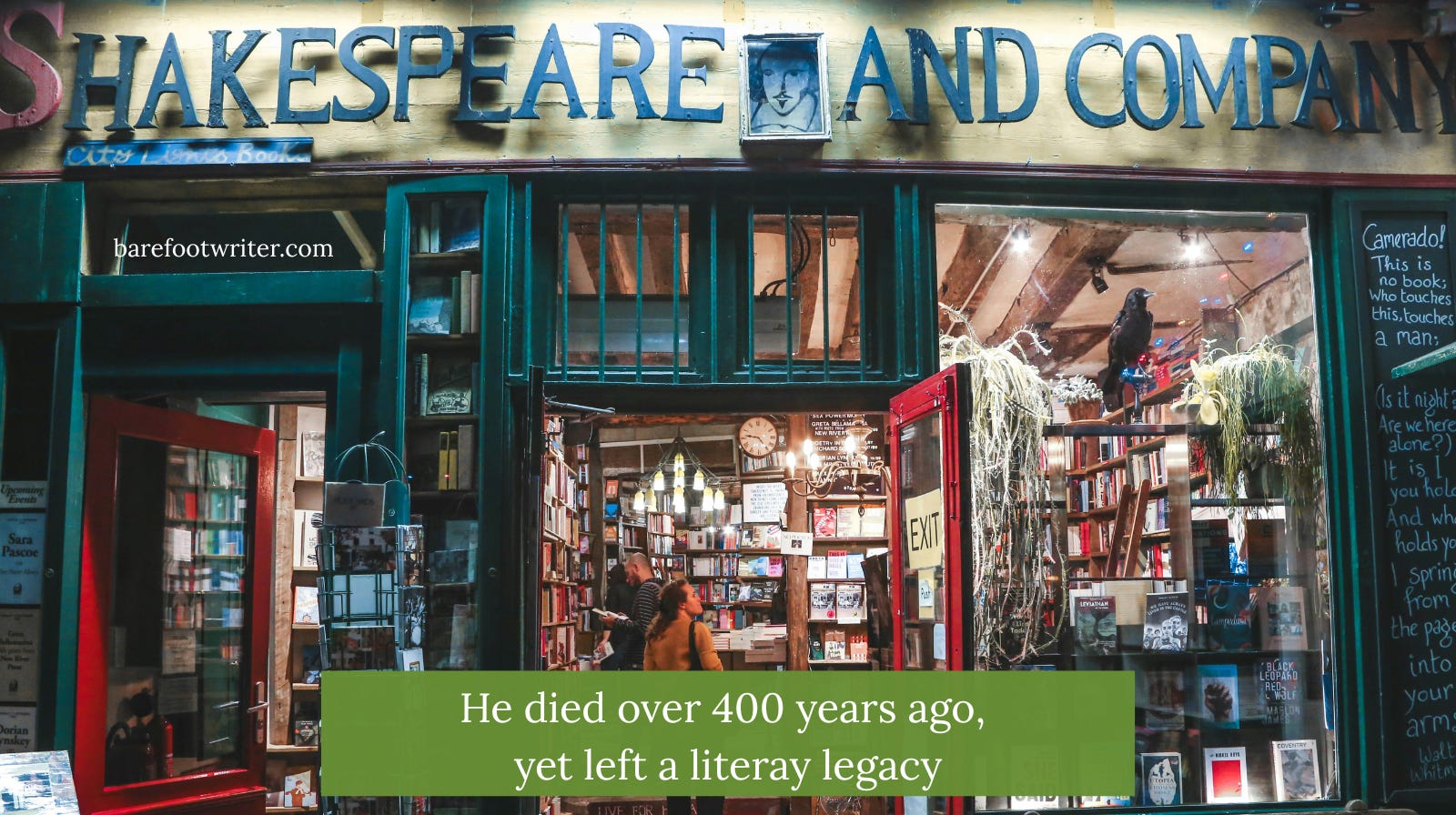
Verily, Things About Shakespeare Ye Didn’t Know
By Katie Yeakle
William Shakespeare is often acclaimed as the greatest writer in the history of the English language. His collective works consist of 37 plays and 154 sonnets.
Most likely, you studied Shakespeare in school and probably know a few facts about him. He was born in Stratford-upon-Avon, England; he was a performer, playwright, and lyric poet (“bard”); and he wrote such plays as Hamlet, Macbeth, and Romeo and Juliet.
But there are probably some things you don’t know about Shakespeare …
For instance, it’s said that Shakespeare was born on April 23, 1564. But did you know that he also died 52 years later … on the same day?
(Although, we have to take his birth date with a smidgen of salt. Nobody knows for sure the day when Shakespeare was born. April 23 is only a close guess and is based on his baptism at the Holy Trinity Church on April 26.)
In Shakespeare’s Hamlet, Polonius gives advice to his son Laertes: “Neither a borrower nor a lender be … ” The Bard most likely learned this advice from personal experience. Shakespeare’s father was a dishonest money lender.
One would imagine Shakespeare was a highly educated man. Forsooth, no. His father took him out of school when young William was only 14 due to financial problems. He had only seven years of schooling.
Despite an abbreviated education, Shakespeare is said to have had a vocabulary of over 29,000 words. Contrast that with the vocabulary of today’s average person — only about 2,000 words in everyday conversation.
Shakespeare, who penned his first play at age 25, was a master at crafting the most magical collection of words in the English language: “To be or not to be … ” and “A rose by any other name would smell as sweet.”
His language was also highly creative as in “mewling and puking in the nurse’s arms” from All the World’s a Stage and “O illiterate loiterer!” from The Two Gentlemen of Verona.
Of the 31,534 words Shakespeare wrote, 14,376 of them appear only once in his works. He also made up more than 1,500 words which we still use today … including “eyeball,” “assassination,” “leapfrog,” and “puke.” He coined more phrases and sayings than any other English writer, most of which are still used today (e.g., wild goose chase, a heart of gold, vanish into thin air).
Most scholars pick Hamlet as Shakespeare’s greatest and most famous work. Among his poems, Sonnet 18 — which begins with “Shall I compare thee to a summer’s day?” — is perhaps the most famous due to the sheer number of times its lines have been used in movies, books, TV programs, and reviews.
Although the Bard died nearly 400 years ago, methinks Hollywood verily loves his works.
Consider there have been more than 300 film adaptations of his plays since the 1930s, with some of the most recent ones being Hamlet, A Midsummer’s Night, and Romeo + Juliet.
Hamlet tops the list with more than 200 movie versions, including some spoofs and interesting remakes such as Green Eggs and Hamlet, A Gay Hamlet, and Last Action Hero. West Side Story and The Lion King II are two of the more than 100 renditions of Romeo and Juliet.
Thank you for all you’ve given us, William. All’s well that ends well.
Hey Mindy.
I did not know .... So interesting.