

Fun fact—travel writing is how I first entered the world of copywriting.
Or should I say, the idea of travel writing brought me in. Back when I was trapped in a 9-to-5 with a long commute and a stiflingly gray office, I’d use my lunch breaks to scroll travel articles like the one below.
As I learned more about travel writing and the people living and loving that profession, I discovered how copywriting was integral to the job. And, presto—next thing I knew I was training to be a copywriter.
If the joy of free travel and getting paid to write about your adventures sounds good to you, you’ll enjoy Roy’s account below of the most epic travel adventure I’ve yet read. (Imagine… so many massages you get tired of them!!)
Even though copywriting became my bread and butter, I did go on to land some travel perks and travel writing jobs of my own. Was it worth it? Absolutely, completely, and without hesitation, yes.
Best of all, once you learn it, travel writing is a skill you can always tap back into if the explorer bug ever hits. Enjoy today’s glimpse into the life of a travel writer.
To your writing success,
Mindy
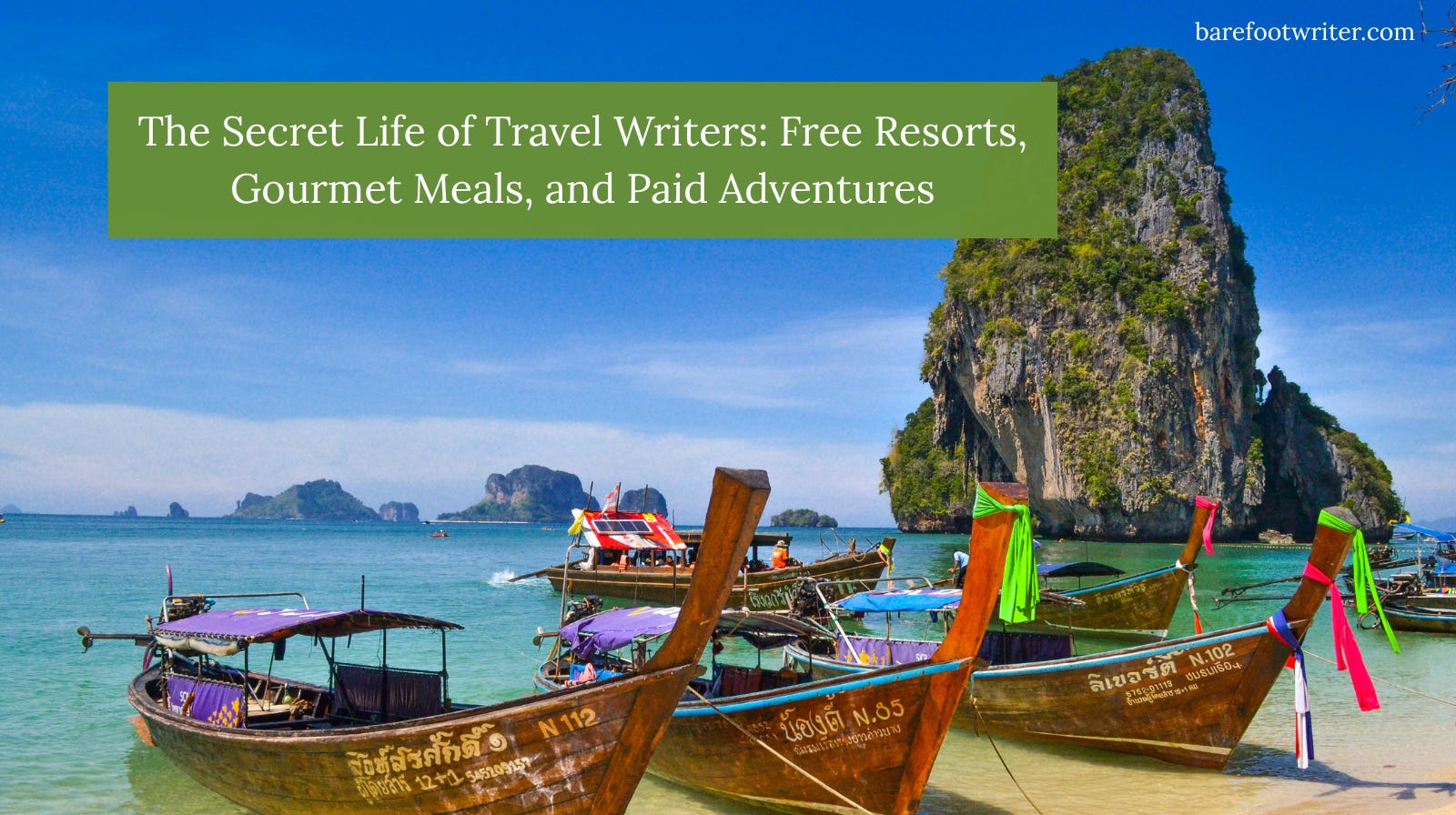
The Priceless Perks of Travel Writing
By Roy Stevenson
Top travel writers are often able to land exciting press trips with most, or all, of their costs covered by tourist agencies and their media outlets — all because they’ve established longstanding relationships with magazine editors.
I’ve scored some spectacular gigs over the past few years of being a travel writer. I get to write in vivid detail about the exclusive resort or spa my wife and I stayed at (with our own personal concierge), how we were treated like royalty, ate gourmet food when we felt like it, and how we toured around in a limousine like VIPs while tourists gawked at us.
For a few short days or a week or two, we live well above our station and get insight into how the really, really rich spend their vacation time. I’ve had three such trips in the past year… and I’m going to tell you about one that seriously rocked.
Last January, my wife (a professional travel photographer) and I tacked a 4-week stay in Bali onto the end of a two-month S.E. Asian tour that started in Singapore, followed by Borneo.
I had widely advertised my assignment — about “Bali’s Most Luxurious Resorts and Villas” — in a number of travel media-related websites. The response was great! Our Bali trip just grew longer and longer as more and more luxury resorts, villas, and boutique spas invited us to stay there, until I finally had to say “enough” when we had 12 resorts and villas lined up, for 28 nights.
Much as I would have liked to spin it out for another month or two, we eventually had to get back to Seattle to do some work.
Bali is a sparkling, stunning, tropical island with ever-changing landscapes overflowing with colorful rice fields and mysterious temples. Its graceful people seem born to welcome guests to their bustling paradise, and they’re happy to show you their fascinating cultural heritage, always with a wide, white toothy smile.
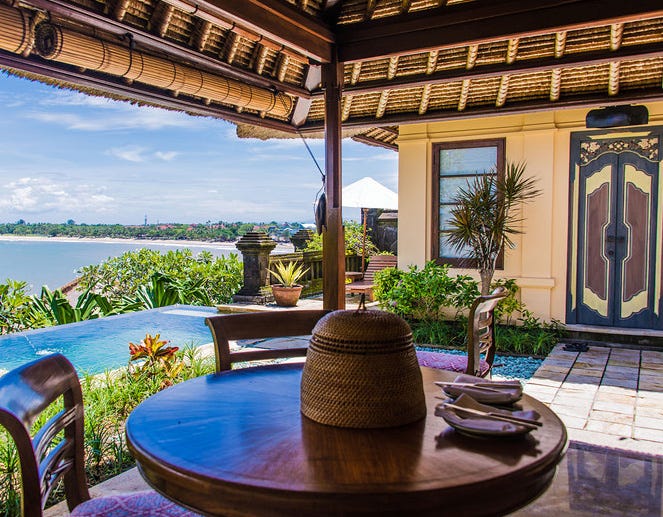
Our assignment resorts and villas were the crème de la crème for the elite. Some of the resorts we stayed at don’t advertise their rates because if you have to ask, you can’t afford it (seriously). More than one resort had helicopter pads — another sure sign of an affluent clientele.
We stayed 2-3 nights each in a wide array of idyllic boutique villas: many with native Alang-alang Balinese architecture, spacious air-conditioned rooms, huge four-poster beds draped with colorful mosquito nets, marble tiled and hardwood floors, private swimming pools, indulgent spas, and top-of-the-line restaurants.
Sungai Gold had, for example, a spectacular courtyard with a large infinity pool overlooking the hillside to the river. Surrounding the pool were outdoor living spaces; a living room pavilion, relaxing beds, and a pool deck with lounge chairs, plus a dining pavilion and gardens.
We were subjected to dozens of spa therapies and Balinese healing treatments. Our two-and-a-half-hour “Love and Connectivity” treatment at one spa included a foot wash, an exfoliation scrub, massage that heals the heart chakra, and a rose oil bath for two. Churlishly, by our fifth resort, I had tired of massages and pampering treatments.
Our memorable gourmet meals included a 3-hour, 8-course Imperial Chinese Dinner seated at a 12-meter long table amidst 18th century artwork, surrounded by the bright red walls of an ancient Chinese temple — definitely a once-in-a-lifetime experience. An equally appealing meal was the Waroeng Jawa, a humble but romantic dining experience in an open-sided hut where an elderly Balinese lady renowned for her authentic old-style cooking prepared our food over an open fire.
We would cool off in crystal-clear swimming pools as the mood took us. Some villas were so gorgeous that we didn’t leave the property for our entire stay.
We earned our keep by inspecting these palaces for an hour or two, escorted by the property owners or media reps. My wife worked 1-2 hours per day to provide images for the article, and I would write up each resort in an hour or two each evening.
Most of us travel writers know we’re not going to get rich with travel writing, but we’ll show you dozens of stamps from exotic countries in our passports — we visit more places in one year than most 9-to-5ers will see in five years.
You can travel like this too. Between your article payments and comp travel, you can have nice inexpensive trips. Even if you hold down a job with regular hours, you can still do this part-time, with some time management and good planning. So next time you look at your passport, imagine what it will look like with most of the pages stamped.