

Every March, I find myself falling a little bit in love with Ireland all over again—not just for the shamrocks, green rivers, and excuses to eat carbs with abandon…
But because so many of the world’s most unforgettable writers hail from its misty shores.
From Wilde’s wit to Yeats’s wonder, the Irish have a way of turning words into magic.
So in honor of St. Patrick’s Day, I’m sharing this lovely article from Katie Yeakle—a literary toast to Ireland’s talent, imagination, and lyrical charm.
Sláinte to words that dance!
To your writing success,
Mindy
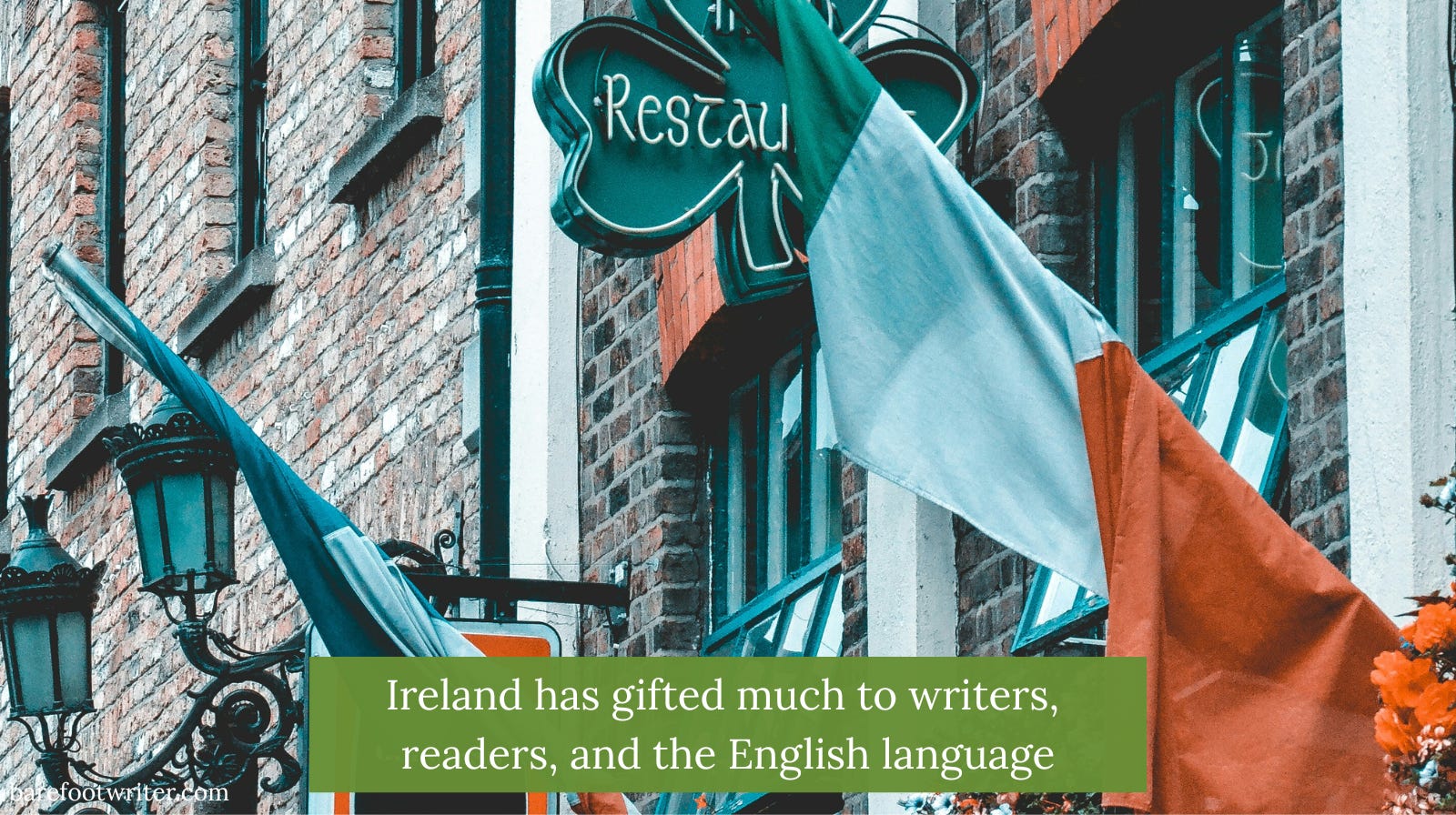
Ireland Is Where Strange Tales Begin and Happy Endings Are Possible
By Katie Yeakle
Many festive activities are associated with Ireland, especially during this month of March when we celebrate St. Patrick’s Day on the 17th.
Whether or not you can be counted among the 35 million or so Irish Americans, chances are good you’ll still celebrate St. Patrick’s Day by wearing green clothing or perhaps even drinking green beer. Or, maybe you’ll watch a parade, eat corned beef and colcannon, and wear a “Kiss Me, I’m Irish” button.
But aside from the Irish music, Irish drinks, and Irish religious traditions that define the very unusual culture of the country, there’s another side of Ireland many do not know. The Emerald Isle has had a major impact on the English language over the course of its history.


The oldest vernacular poetry in Europe comes from Ireland, going back as far as the 6th century. In 1923, William Butler Yeats, Ireland’s most famous poet, was the first Irishman to be awarded the Nobel Prize in Literature. A more contemporary Irish poet, Seamus Heaney, won the Nobel Prize in Literature in 1995.
The Nobel Prize in Literature also went to two other Irishmen: George Bernard Shaw and Samuel Beckett. And then James Joyce, Oscar Wilde, and Jonathan Swift, though not Nobel Prize winners, are among other famous Irish scribes.
Joyce is best known for his tome Ulysses, which laid the foundation for the modern novel. He also wrote Dubliners, a collection of short stories about the lives of the Irish, and two other novels, A Portrait of the Artist as a Young Man and Finnegan’s Wake.
Wilde, a witty, flamboyant novelist, playwright, poet, and all-around intellectual, is best known for his novel The Picture of Dorian Gray and the humorous play The Importance of Being Earnest.
Swift, one of the first modern satirists, is best known for writing the travel satire Gulliver’s Travels and A Modest Proposal, in which he proposes that Irish children should be eaten in order to deal with the problems of hunger and homelessness facing the Irish.
Thanks to their gift of gab, Irish sayings, proverbs, and witticisms have flowed freely like Guinness from such acclaimed writers as Wilde, Shaw, and Brendan Behan to the commoner one meets at an Irish pub:
“Ireland is where strange tales begin and happy endings are possible.”
“May the luck of the Irish be with you!”
“I can resist everything but temptation.” (Oscar Wilde)
“It is often that a person’s mouth broke his nose.”
“I am a drinker with writing problems.” (Brendan Behan)
“As they say in Ireland: ‘May you be forty years in heaven before the devil knows you’re dead.’”
“A life making mistakes is not only more honorable, but more useful than a life spent doing nothing at all.” (George Bernard Shaw)
“May the road rise up to meet you,
May the wind always be at your back,
May the sun shine warm upon your face,
And rains fall soft upon your fields.
And until we meet again,
May God hold you in the palm of His hand.”
Great read! I'm part Irish myself. I remember reading some of these great works in high school. I'd like to read more of them, so thank you for sharing this celebration of Irish Writers (say that five times fast).