

Dale Carnegie wrote How to Win Friends and Influence People in 1936.
Nearly a century later, the message still rings true.
What I love about today’s piece is how relatable Katie made it. She went back through Carnegie’s book and pulled out 18 gems that apply directly to your work as a persuasive writer. Not “in a general sense,” but right now, on your current assignment.
You’ll nod your head at some of these. One or two might stop you cold.
Gem #5 is the one I’d keep taped above my desk.
And gem #18 — if you’ve ever struggled to make a true thing feel true on the page, that one’s for you.
To your writing success,
Mindy McHorse
Executive Editor, Barefoot Writer
Thanks for reading! Subscribe now to get your free report on 9 Ways to Make a Great Living as a Writer.📝💵🌴

18 Gems for Persuasive Writers … And More!
By Katie Yeakle
Now, as you’re shaping your career as a freelance writer, I’d like to share some notes I sent to the team at American Writers & Artists Inc. (AWAI) a few years back.
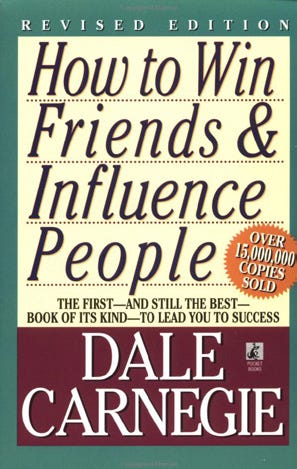
I had just re-read Dale Carnegie’s How to Win Friends and Influence People and was inspired by the power, honesty, and simplicity of his message.
These first few points, I think, are especially meaningful to you as Barefoot Writer subscribers.
In fact, as you read Dale’s words, I’d like you to substitute “Barefoot Writer connection” for “book.” Read on…
Dale reinforces the importance of what he’s teaching and the impact it can have on your life… all the while pointing out that our success is ultimately up to us:
“If you want to get real, lasting benefit out of this book, don’t imagine that skimming through it once will suffice. After reading it thoroughly, you ought to spend a few hours reviewing it every month. Keep it on your desk, in front of you every day. Glance at it often. Keep constantly impressing yourself with the rich possibilities for improvement that still lie in the offing.”
Dale’s clear about the fact that there’s work involved… but the work is worthwhile… and the results are worth it. Two examples:
“Remember that the use of these principles can be made habitual only by a constant and vigorous campaign of review and application. There is no other way.”
“Learning is an active process. We learn by doing. So, if you desire to master the principles you are studying in this book, do something about them. Apply these rules at every opportunity. If you don’t, you will forget them quickly. Only knowledge that is used sticks in your mind.
“You are attempting to form new habits. Ah yes, you are attempting a new way of life. That will require time and persistence and daily application.”
And then there are these 18 gems from Dale’s book that, if applied, I guarantee will make you a better persuasive writer starting today:
“There is only one way under high heaven to get anybody to do anything… And that is by making the other person want to do it.”
“ …the deepest urge in human nature is ‘the desire to be important’… ‘the craving to be appreciated.’”
“I consider my ability to arouse enthusiasm among my people,” said Charles Schwab, “the greatest asset I possess, and the way to develop the best that is in a person is by appreciation and encouragement.”
“Try leaving a friendly trail of little sparks of gratitude on your daily trips.”
“ …the only way on earth to influence other people is to talk about what they want and show them how to get it.”
Quoting Henry Ford: “If there is any one secret of success, it lies in the ability to get the other person’s point of view and see things from that person’s angle as well as from your own.”
Quoting a performer: “I am grateful because these people come to see me. They make it possible for me to make my living in a very agreeable way. I’m going to give them the very best I possibly can.”
“If we want to make friends, let’s put ourselves out to do things for other people — things that require time, energy, unselfishness, and thoughtfulness.”
Chinese proverb: “A man without a smiling face must not open shop.”
“Your smile is a messenger of your goodwill. Your smile brightens the lives of all who see it. To someone who has seen a dozen people frown, scowl, or turn their faces away, your smile is like the sun breaking through the clouds. Especially when that someone is under pressure from his bosses, his customers, his teachers, parents, or children, a smile can help him realize that all is not hopeless … that there is joy in the world.”
It’s all about listening to the other person.
“The unvarnished truth is that almost all the people you meet feel themselves superior to you in some way, and a sure way to their hearts is to let them realize in some subtle way that you recognize their importance, and recognize it sincerely.”
Advice Dale received after correcting someone publicly at a dinner party: “Why prove to a man he is wrong? Is that going to make him like you? Why not let him save his face? He didn’t ask for your opinion. He didn’t want it. Why argue with him? Always avoid the acute angle.”
“Nine times out of ten, an argument ends with each of the contestants more firmly convinced than ever that he is absolutely right.”
“Suppose you triumph over the other man and shoot his argument full of holes and prove that he is non compos mentis. Then what? You will feel fine. But what about him? You have made him feel inferior. You have hurt his pride. He will resent your triumph. And — a man convinced against his will, is of the same opinion still.”
“In talking with other people, don’t begin by discussing the things on which you differ. Begin by emphasizing — and keep on emphasizing — the things on which you agree. Keep emphasizing, if possible, that you are both striving for the same end and that your only difference is one of method and not of purpose.”
Appeal to nobler motives.
Merely stating a truth isn’t enough. The truth has to be made vivid, interesting, dramatic.
Next time you sit down to write anything… a sales letter, a business memo, a note to a friend… I hope you’ll keep Dale’s advice in mind.